
If there’s one Google Ads lever that quietly drives impact, it’s negative keywords. They don’t get the same attention as bidding strategies or flashy AI updates, but when it comes to performance, they’re doing a lot of the heavy lifting behind the scenes.
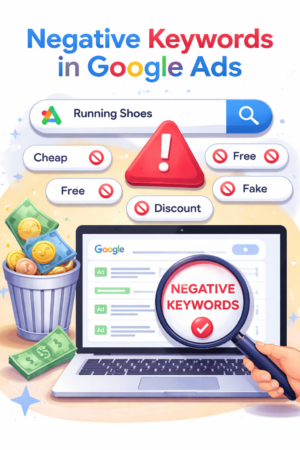 At their core, negative keywords tell Google when your ads should not show. And in a pay-per-click world, knowing where not to spend is just as important as knowing where to lean in.
Why Negative Keywords Are Non-Negotiable
Without negative keywords, Google Ads can cast too wide of a net. Your ads may appear for searches that technically relate to your product, but signal little to no buying intent.
Say you’re advertising premium skincare. Searches like “free skincare,” “DIY face cream,” or “cheap moisturizer” might trigger your ads, but they’re unlikely to convert. Those clicks eat up budget without delivering results. Negative keywords prevent that waste before it starts.
Higher Intent Traffic, Better Performance
Negative keywords improve the quality of your traffic, not just the quantity. When irrelevant searches are filtered out:
- Click-through rates increase
- Conversion rates improve
- Cost per acquisition drops
Over time, this relevance also supports stronger Quality Scores, which can lower your cost per click and make your campaigns more efficient overall.
In short: fewer junk clicks, more meaningful ones.
Budget Protection That Scales
Every dollar matters, especially in competitive accounts. Negative keywords act as a safeguard, ensuring your spend goes toward searches with real intent instead of curiosity clicks.
This is particularly critical when you’re running:
- Broad or phrase match keywords
- High-CPC campaigns
- New accounts still learning performance signals
A well-maintained negative keyword list is often the difference between profitable growth and slow budget leakage.
Why Negative Keywords Still Matter in an AI-Driven World
With Smart Bidding and automation doing more of the heavy lifting, it’s tempting to assume negative keywords are no longer necessary. In reality, they’re more important than ever.
Automation needs clear guardrails. Negative keywords help train the algorithm by removing low-intent searches from the equation, allowing Google’s AI to focus on what actually converts.
Think of them as strategic boundaries, not restrictions.
How to Build (and Maintain) a Strong Negative Keyword List
The best insights usually come straight from your data:
- Search Terms Reports in Google Ads
- Customer questions and support inquiries
- On-site search behavior
- Common intent modifiers like “free,” “jobs,” “how to,” or “reviews” (when they don’t align with your goals)
This isn’t a set-it-and-forget-it task. Reviewing search terms and adding negatives should be part of your ongoing optimization rhythm.
Negative keywords may not be flashy, but they’re foundational. They protect your budget, sharpen your targeting, and make every other optimization work harder.
Positive keywords tell Google who you want to reach. Negative keywords make sure you’re not paying for everyone else.
When you’re ready to focus on your business and let the Google professionals help, contact us!